Some of the most powerful meditations I ever practised weren’t on a cushion. I was on my feet, walking through the Kent countryside, far from any sign of other people. For years, that was the only place I could meditate at all. I had to get as far away from people as I possibly could. So when people ask me how to bring mindfulness into their lives without carving out yet another slot in an already full day, I often point them outdoors, and I encourage them to start walking.
This article works through four practices that sit naturally together: mindfulness, mindful walking, walking meditation, and forest bathing. They form a gentle progression, from a quality of attention you can carry anywhere, all the way to a deep immersion in nature. You do not need special equipment or a great deal of time. You need a pavement, a park, or a patch of countryside, and a willingness to notice where you already are.
Mindfulness
Before we walk anywhere, it helps to be clear about what mindfulness actually is. It is not emptying your mind, and it is not adding one more thing to your to-do list. Mindfulness is the undistracted awareness of the experience of the present moment. We don't need to be immersed in our experience for it to be mindfulness. But if we are immersed, then we are experiencing mindfulness. In any case, I prefer the word ‘presence’. So much of our day is spent somewhere else entirely, often rehearsing a future conversation or replaying a past one.
The good news is that mindfulness doesn’t require a quiet room. It can be trained anywhere: while you eat, while you wait for the kettle, and, as we are about to explore, as you walk.
Mindful Walking
Mindful walking is the most accessible practice of all, because you are almost certainly walking somewhere today anyway. The idea is to walk at your normal pace, with your attention open to what is around you, and to gently return that attention every time you notice it has drifted.
Essentially, there is no difference between this and the famous breathing meditation (following the breath), where we focus on our breath and when our mind wanders, we return our attention to it.
You don’t have to slow down or notice your feet on the ground (though you can do that if you wish). You are just walking, but awake to it. You can feel your feet on the ground. Notice the air on your skin, the sounds around you, the light. When your mind pulls you back into thinking, which it will, you gently, patiently return your attention to your present moment experience.
I often suggest using something in the environment as a gentle reminder. Lampposts work well. Each time you pass one, let it nudge you back to the sounds around you. Your commute can then become fertile ground for a mindfulness practice: the walk to the station, the platform, the train. These are not dead time to be endured. They are opportunities you already own.
There is one thing worth knowing, because it took me a long time to learn it. I once set myself the task of walking the seven minutes to Bromley South station without my mind wandering. I tried many times and always failed. The first time it worked was the first time I stopped trying. I stopped ‘trying to be present’ and instead taught myself to be ‘aware that I am present’. This is a subtle difference. When you strain toward presence, the straining gets in the way. So walk gently. Replace trying with noticing.
Walking Meditation
Where mindful walking is informal and can happen on any journey, walking meditation is deliberate. Here, you set aside a short stretch of time purely for the practice, and you slow right down.
My single most successful podcast episode is a walking meditation and guided mindful walk. If you'd like to try it, it's about 25 minutes long. You can plug in before you go out for your walk or before you start your walk. And listen to it at your leisure.
Guided Practice for Walking Meditation
Here is the link: Guided Walking Meditation Podcast Episode

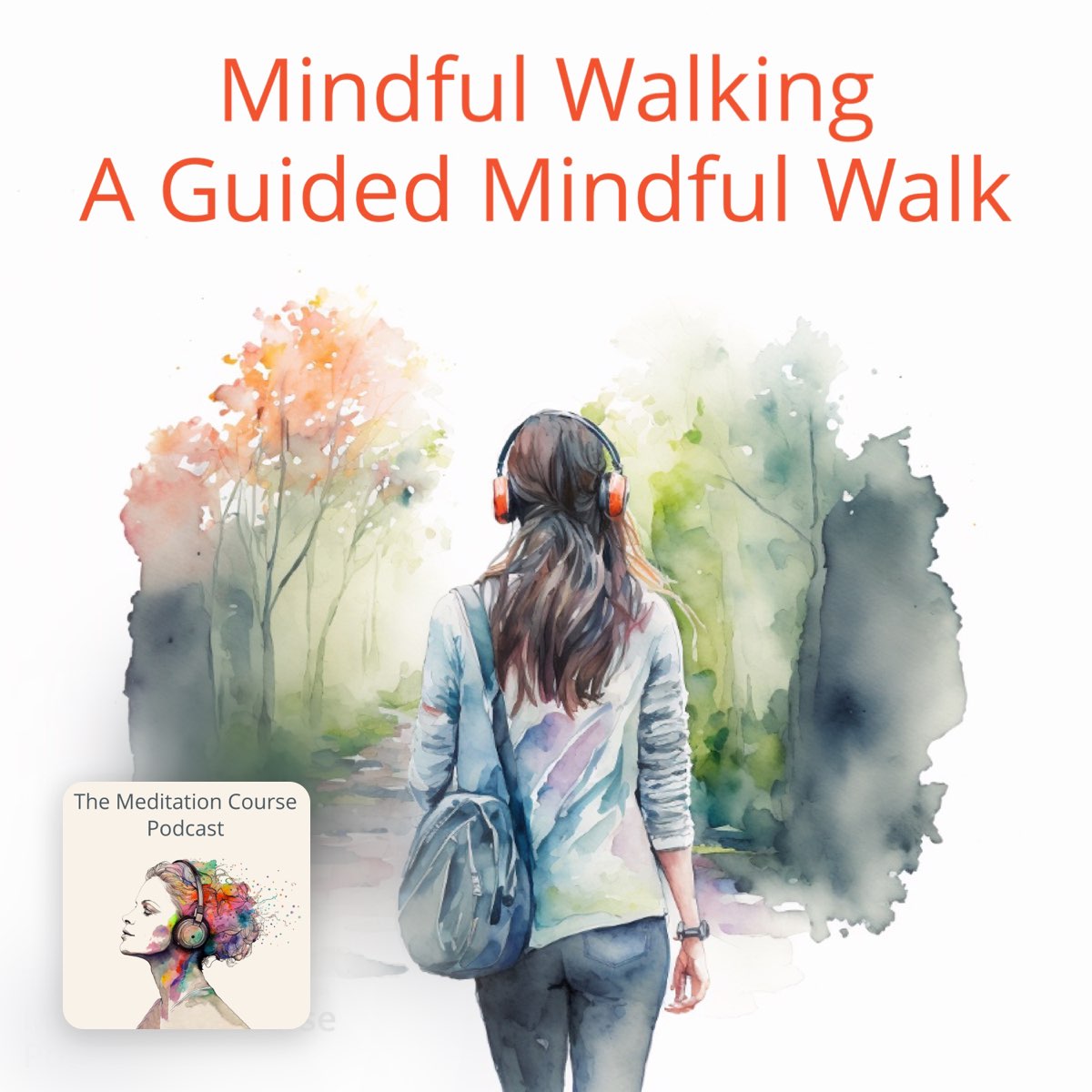
This is one of the practices I group under what I call the Frictionless Way, my approach to weaving meditation into a busy life with as little resistance as possible. People with the fullest lives need the most accessible practices, not the most demanding ones. Walking meditation asks very little of you and gives a great deal back. A few slow minutes are enough to change the texture of a whole day.
Forest Bathing
Forest bathing is where walking with nature reaches its full depth. The term is a translation of the Japanese shinrin-yoku, which means immersing yourself in the experience of the forest. It is not an exercise, and it is not a hike. It is slowing down among the trees and letting your senses drink the place in.
This practice is deeply personal for me. In the years when I was too worn down by modern life to meditate anywhere else, I would take a train into the countryside, walk away from the traffic noise and the flight paths, find a tree, and sit down. I was forest bathing before I ever knew it had a name. On one of those evenings, a grouse walked past me at twilight, no more than ten feet away, entirely unaware that I was there. That is the kind of stillness nature can give you.
If you want to try it, keep it simple. Find some woodland or a green space with trees. Leave your phone in your pocket. Walk slowly, with no destination, and let your senses lead: the smell of the earth, the movement of the leaves, the sounds layered around you. You learn that the forest is alive, and you connect with that aliveness through the sounds and smells. What you can say is that you can see.
You do not need to do this every day for it to work. Some of the greatest progress I ever made came from these nature meditation and walking meditation sessions, just once or twice a fortnight. They were rituals, not routines.
Bringing It Together
So the next time you step outside, try treating the walk not as the gap between two places, but as the place itself. Feel your feet on the ground, let the world in, and remember that you are here. That is where presence lives, and it has been waiting for you all along.