Welcome to the weekly insights post for this week.
I post a Weekly Insights article each week. Each article is a roundup of the insights that I've posted the previous week across all my social media platforms. Each insight is a micro-learning post offering practical guidance on mindfulness, meditation, and resilience.
This week's Topics:
- About the Frictionless Way
- The Power of The Breath
- Posture
- Biohacking
- Post 4 of my Barriers to Meditation Series:
About the Frictionless Way
Overwhelm is growing. Personal admin feels like a full-time job. Everything's online now—deliveries, subscriptions, passwords, PINS, emails and messages that never stop.
The hamster wheel doesn't have a pause button.
The UK now reports some of the highest levels of psychological overwhelm in the world. Research from Sapiens Labs (using the global Mental Health Quotient survey) confirms what most of us already feel: we're drowning in complexity.
We ranked second-lowest overall among 80 countries—only Uzbekistan scored lower.
When life feels like this, the most important thing becomes simply taking the next step… and the next. We sacrifice personal time until it becomes an occasional treat.
To improve our lives, we need to do the things that help, like meditation. But when we're exhausted, we don't have the time or energy to meditate. This is the Catch-22 of Meditation.
The Frictionless Way is the solution. It's a set of practices we can integrate seamlessly into everyday life. These are the practices my students use.
Instead of adding meditation to your schedule, we work with what you already have. You continue doing what you already do—your daily activities become meditations.
Some of these practices are literally zero effort.
Read on and stay tuned to my social media and to these weekly insights to learn more...

The Power of The Breath
Your breath does two very different things
1️⃣ Focus your attention on the coolness and sharpness of the in-breath. Just keep your awareness there for a few breaths. You will notice that your mind becomes calmer. You're back in the present moment from whatever narrative was running in your mind.
2️⃣ Then, when you shift your focus to the movement of your belly rising and falling in time to the breath, something else happens. The body relaxes, and over time, your stress drifts away.
Same breath. Different focus. Opposite effects:
- The first technique gets you here. ⏰
- The second technique keeps you here.🎯
With these two techniques, you shift your awareness from mental chatter into the dimension of time: the present moment.
Once you've done this often enough, it becomes part of you. Your subconscious wants you to be balanced, focused, and calm and relaxed. So it will initiate this practice once you've trained it enough.
You won't have to remember to do it or think about it; it just happens. And you'll notice your body kicking into gear, using your breath to help you gain focus and calm.
Posture
Most relaxation advice starts with your breath.
But there's a simpler starting point: your elbows!
When you lean forward — arms reaching for a keyboard, phone, or steering wheel — your neck and shoulders work overtime. They're constantly lifting your head. This creates tension you may not even notice.
Here's a quick fix: Move your elbows back to your sides. Let your arms hang naturally. Something interesting happens:
- Your head finds its own balance.
- Your back straightens without conscious effort.
- Your shoulders soften.
You've just removed the tension at its source.
A balanced posture doesn't require muscles to maintain it. Each body part rests comfortably on its support.
You can forget about "sitting up straight," or "keeping your back straight!" That's swapping one tension for another.
Instead, find the position where everything balances — and then let gravity do the work.
🪑 Try it now: Sit however you're sitting. Adjust the forward and backward position of your elbows until your head balances as comfortably as possible. Notice what changes.

Biohacking
Your body is run mainly by a single interconnected system. This system manages your stress levels, among other things. It's called the Autonomic Nervous System (ANS). The ANS is mainly subconscious, but you can hack into it to regulate your stress levels.
This is called Biohacking.
Here are 7 biohacks you can try right now - together if you wish:
1️⃣ Release your jaw tension – Place your tongue gently against the back of your top teeth. Let the tip rest lightly on the sharp edge of your bottom teeth. Notice the jaw softens.
2️⃣ Present-moment connection - Focus on either the tiny movement of your belly as it rises and falls, or on the passage of background sounds through time.
3️⃣ The right way to practice the famous Chin Mudra - Bring your thumb and first finger close together. Almost touching. Don't press. Just hover. Maintain this lightest possible touch, and over time, your hands will relax.
4️⃣ Extended exhale – Make your outbreath slightly longer than the inhale by making it slightly internally audible so only you can hear. Soft and quiet exhales. This signals safety to your nervous system.
5️⃣ Adopt an open, balanced, and relaxed posture – Place your elbows by your side and balance your head as comfortably as you can on your spine. Neck tension often disappears when you find the ideal spot. See my last post for more on this.
6️⃣ Eye centre focus – Rest your attention in the middle of your eyeballs or the space between your eyes. Let your eyebrows, eyes and cheeks soften with each outbreath.
7️⃣ Panoramic vision – Gaze into the distance without focusing on anything specific. This naturally calms the nervous system.
🌿 See how The Frictionless Way offers soft, gentle and easy-to-integrate practices you can use to improve your quality of life with very little effort.
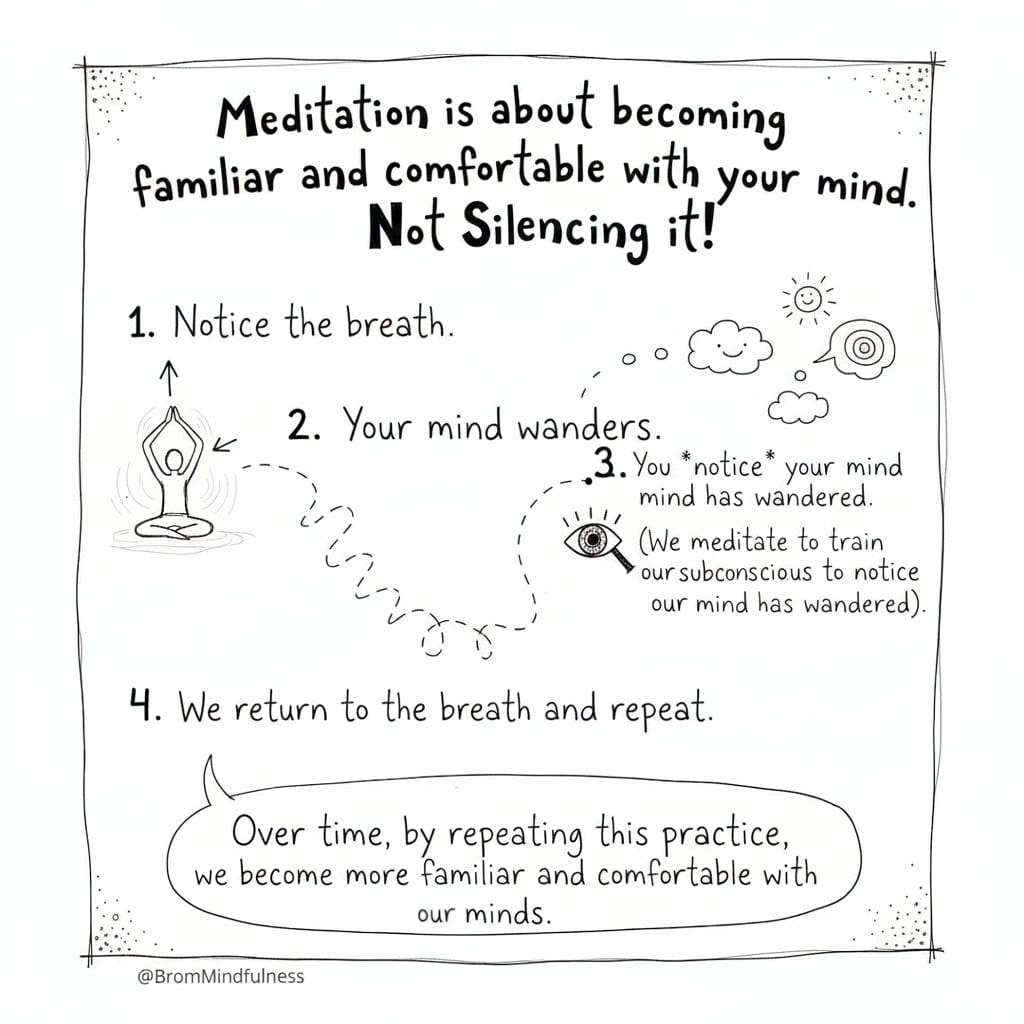
Post 4 of my Barriers to Meditation Series: "It's not calming my mind!"
The main benefit of meditation doesn't happen *during* the practice. It happens later – in your ordinary day.
- You sit. 🧘♀️
- You focus on your breath. 🔎
- Your mind wanders. ☁
- You notice. 👀
- You return to the breath and repeat. 🔁
…and so it goes on. Like a long mind-wandering session that convinces you you’re “no good” at meditation 🙃
This cycle isn't a failure. It's the whole point.
You're training your subconscious to notice itself wandering.
You won't notice this skill growing while you meditate. You'll notice it at work. At home. In conversation.
And you will then catch yourself lost in worry – and discover that you have a choice. You can choose what to focus your attention on.
That choice is everything. Because without it, your attention belongs to everyone else:
- Your inbox
- The news cycle
- Social media algorithms
- Other people's urgency
- Past events
- Future worries
Meditation isn't about achieving calm on the cushion. (Although it is nice when that happens 🙂)
Meditation is about building the only skill that lets you choose where your mind goes.
📌 The meditation is the training. The results show up in your life.
The Meditation Course is delivered as four live, online group-guided meditation classes each week. The course teaches practical, science-based practices to retrain your mind for resilience, focus, calmness, and connection.