Welcome to the weekly insights post for this week.
I post a Weekly Insights article each week. Each article is a roundup of the insights that I've posted the previous week across all my social media platforms. Each insight is a micro-learning post offering practical guidance on mindfulness, meditation, and resilience.
This week's insights are all from the frictionless way framework, which is a collection of practices that I have learned help students the most in return for the least time and effort and without necessarily having a scheduled commitment that you don't break to daily meditation, which is so difficult for so many of us now.
This is meditation for the modern world.
Posts from the Frictionless Way framework:
- Sound meditation
- Third eye focus
- The self-compassion practice
- The Inner Sentinel
- Opportunistic meditation
If you're enjoying this series, then sign up for free to get it delivered directly to your inbox every week. A refreshing alternative to the Sunday papers.

Sound Meditation
A quick & simple sound meditation you can do whenever you have a quiet moment.
Sometimes all it takes is a tiny shift in perception to change your state of mind and reduce stress and tension. 🌿
Try this:
- Close your eyes (or look softly down past the tip of your nose).
- Instead of listening for sounds, listen to all sounds.
- The ambient background sounds, the hubbub hum of life around you.
- Notice the ambient sound moving through time… like a flowing stream of the vibrations of life unfolding around you.
- If your mind wanders, gently return your attention to the passage of sound through time again.
Easy. 💫
Why it works:
- Closing your eyes or looking down removes visual distractions
- Observing sound anchors you in the present moment
- Attention shifts → the inner chatter softens and calms
Notice that the busy mind calms and pauses — even if only for a moment.
Third Eye Focus
✨ The Third Eye: A Big Shift From a Simple Change of Focus
Third-eye meditation refers to the practice of focusing on the space between the eyes. This is traditionally referred to as the third eye by the Yogis.
Note that we don't focus on a single point, but on the entire area that includes the centre of the forehead, between the eyebrows, and between the eyes.
Remember, don't use a deep, intense, concentrative focus, but rather a soft, gentle awareness. This is what I call light-touch focus. 🪶
Here's the practice:
🔹 Focus your attention on the general area between your eyebrows
🔹 Keep the focus soft and gentle - no intense concentration
🔹 With each out-breath, let go of tension from your body and thoughts from your mind
🔹 When your mind wanders, simply guide your attention back
Tap or right-click to save this image to your photos for easy reference.
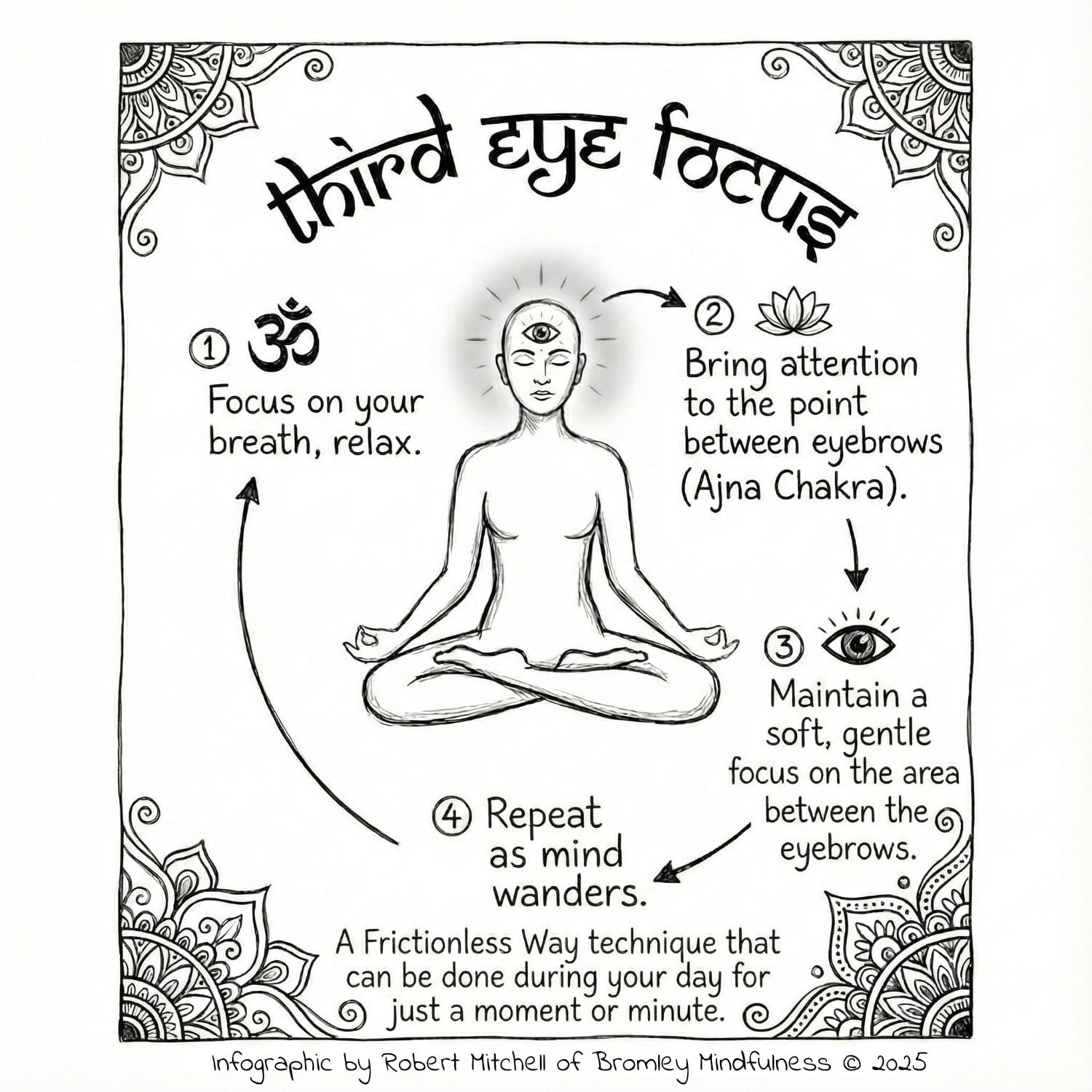
This is what I call balanced focus. It is a focus that allows us to be aware of the body while also being aware of the sounds and the space around us.
What you might notice:
✨ A subtle shift in how you perceive things
😌 Tension releasing from your face and shoulders
💚 Calmness
Some extensions you can add to cultivate the practice:
- Touch your thumb and first finger together lightly (Chin Mudra)
- Rest your tongue against the back of your top teeth so it's gently in contact with the sharp part of the lower teeth.
- Let your out-breaths extend into gentle sighs
This practice helps you step back from the constant mental chatter. Instead of being caught up in thoughts, you become the witness watching them pass.
You don't need to make anything happen. Just rest your attention and observe.
Just focusing on this area can trigger a shift toward calmness, away from stress, tension, and anxiety.
Stay tuned to this channel for more daily easy-to-practice Frictionless Way techniques.
Self-Compassion
A simple practice you can do anywhere to help you lighten the load
There’s a whole library of beautiful practices called Loving-Kindness Meditations.
These practices help us cultivate:
✨ Warmth
✨ Positivity
✨ Self-support
✨ Emotional resilience
Some of these practices are as simple as repeating a few phrases designed to turn compassion inward. 🤍
I’ve chosen one of these as a Frictionless Way practice because it’s quick and easy, and you can use it whenever you need a moment of self-compassion or a warm, connective focus for your attention.
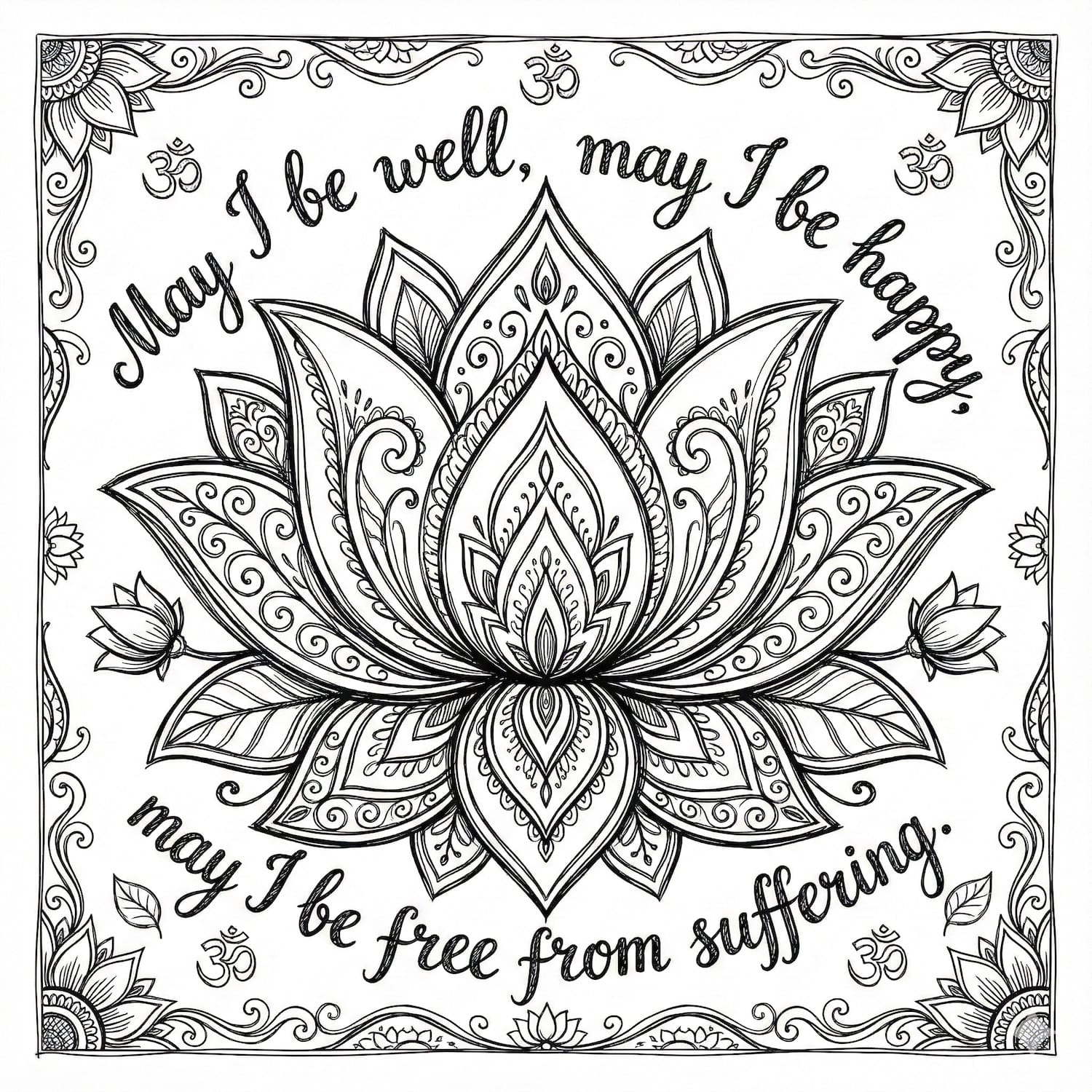
Just repeat — silently in your mind or softly out loud:
“May I be well,
May I be happy,
May I be free from suffering.
A tiny shift in intention… and you begin to cultivate a warm feeling directed inwards.
Why not try it now? 🌿
🕯️ The Inner Sentinel Meditation
Your attention already has a built-in feedback system — you just need a way to switch it on. 💡
This meditation uses one simple image: a candle flame.
Here’s how it works 👇
- Close your eyes and picture a candle.
- The flame burns perfectly still — no flickering, no movement.
- While your attention remains focused on the flame, it remains steady.
- A wisp of smoke drifts upward. A drop of wax slides down.
- The flame remains calm and unmoving. 🕯️
- If your mind wanders, the flame begins to flicker. 🌬️
This is the practice:
🔹 Focus your attention gently on the still flame
🔹 When the mind wanders, the flame flickers
🔹 return your attention to the flame
🔹 The flame becomes still
🔹 Repeat
You don’t need to be a “good visualiser” for this to work.
Some people see an image in their minds. Others sense the flame.
It's all the same. This isn't a visualisation exercise. It's an exercise in presence. 🌟

Opportunistic Meditation
✨ Opportunistic meditation ✨ is a term I learnt from one of my students, who used it to explain when and where they meditate.
Because our lives are so crowded, even the best intentions can get overridden by the intensity of the day.
We struggle to get back into the habit of meditating, which creates a continuous loop of building a habit, dropping it, building it, dropping it, on repeat...
Opportunistic meditation is about either supplementing a regular practice or, for some of us, meditating without a fixed schedule.
One advantage of this approach is that we can learn to meditate everywhere and anywhere:
🚶 A few quiet moments on a journey
🚂 While you're commuting
🏢 In the office!
🏡 When you have a few minutes to yourself at home
All of these (and more) can become opportunities for meditation.
One practice you can do with limited time is the Inner Sentinel meditation I described in the previous section.
If you're struggling to build or maintain a practice, give yourself a break for a week or two and try this out to see how it goes.
I'd love to hear from you if you do this or if it works for you.