Welcome to the weekly insights for Sunday, 30 November.
I post a Weekly Insights article each week. Each article is a roundup of the insights that I've posted the previous week across all my social media platforms. Each insight is a micro-learning post offering practical guidance on mindfulness, meditation, and resilience.
In addition, this week I have published a podcast episode (a recording of the Saturday class)—the first in a while.
This week's Topics
- The Labelling the Quality of Thoughts Meditation
- Incremental Relaxation
- The Parable of the Woodcutter
- The Candle Visualisation Meditation
- Mindfulness Meditation Explained (Podcast Episode)
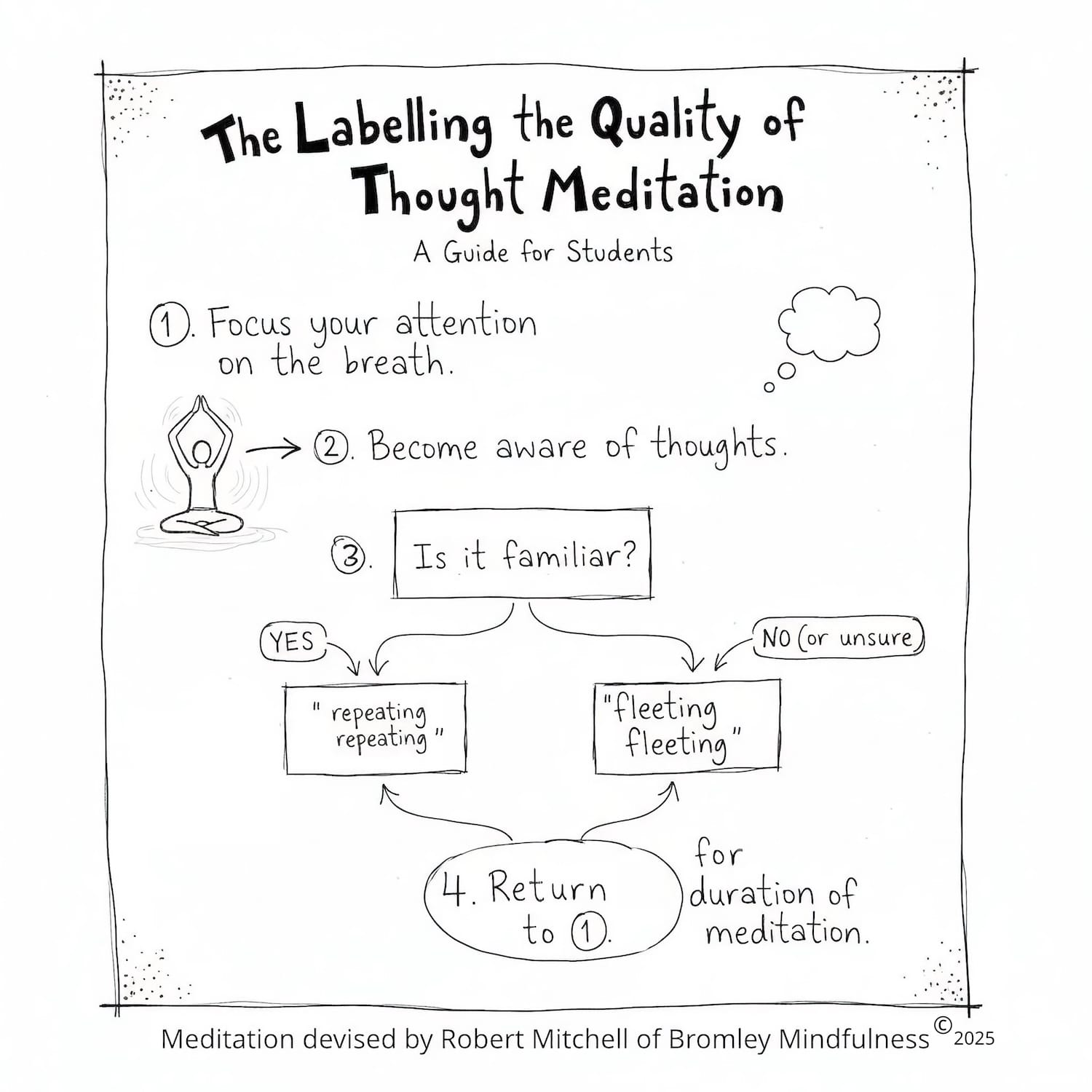
Labelling the Quality of Thought
This practice, which I devised, adds an extra layer to the ancient 'Labelling the Thoughts' meditation.
In addition to the traditional practice of labelling our awareness of thought, we are also making an intuitive choice as to whether we recognise whichever thought has arisen.
Whether your thoughts are familiar or unfamiliar is irrelevant. The purpose of this practice is to refine the sensitivity of our focus on thought.
This refined sensitivity to thought is an important element in becoming increasingly familiar and comfortable with the mind.
Remember that the ultimate goal of meditation is to become familiar with the mind, as Mingyur Rinpoche teaches.
In addition to teaching this as a focused attention practice, it is also effective as a Yoga Nidra that helps us slip into a hypnagogic state, which is a great sleep initiator, and can help with recovery from dream sleep deprivation. So I often teach it in my Sleep Course.
I have rarely taught this out of my student base, so if this practice is new to you, I would love to hear how you get on with it. Feel free to leave a comment. 👇
Incremental Relaxation
Stress lives in the tension in our shoulders, neck, face, jaw and even in our hands.
Incremental relaxation helps you progressively let go—a little more with each breath, a little more with each meditation.
🧘♂️ How it works:
• Extend your exhale by making it ever so slightly audible so only you can hear.
• Tune into subtle tension in areas like the shoulders, neck, back, face, wrists and fingers.
• As you exhale, gently repeat in your mind: “releasing” (you are connecting the relaxing out-breath with focus on a point of tension).
• Allow relaxation to move softly through the body — just like slowly opening a tap.
✨ Over time:
Your ability to relax improves.
You start to reconnect with your body and feelings more easily.
We don't make ourselves relax; we associate our focus on a tense part of our body with a relaxing out-breath, and in time, the body does the rest.

A Story On Impatience
An ancient story tells about a woodcutter who worked all day chopping trees. As each day wore on, he would slow down with each hour. His swings took more effort, and he cut less wood.
A passing monk stopped for a moment one day, watched the woodcutter and asked, "Why don't you stop and sharpen your axe?"
"I can't stop," the woodcutter replied. "I have too much wood to chop."
This is how many of us live: Too busy to rest. Too overwhelmed to pause. Too much to do to take a break.
For an overburdened or overwhelmed mind, meditation is like sharpening the axe. ✨
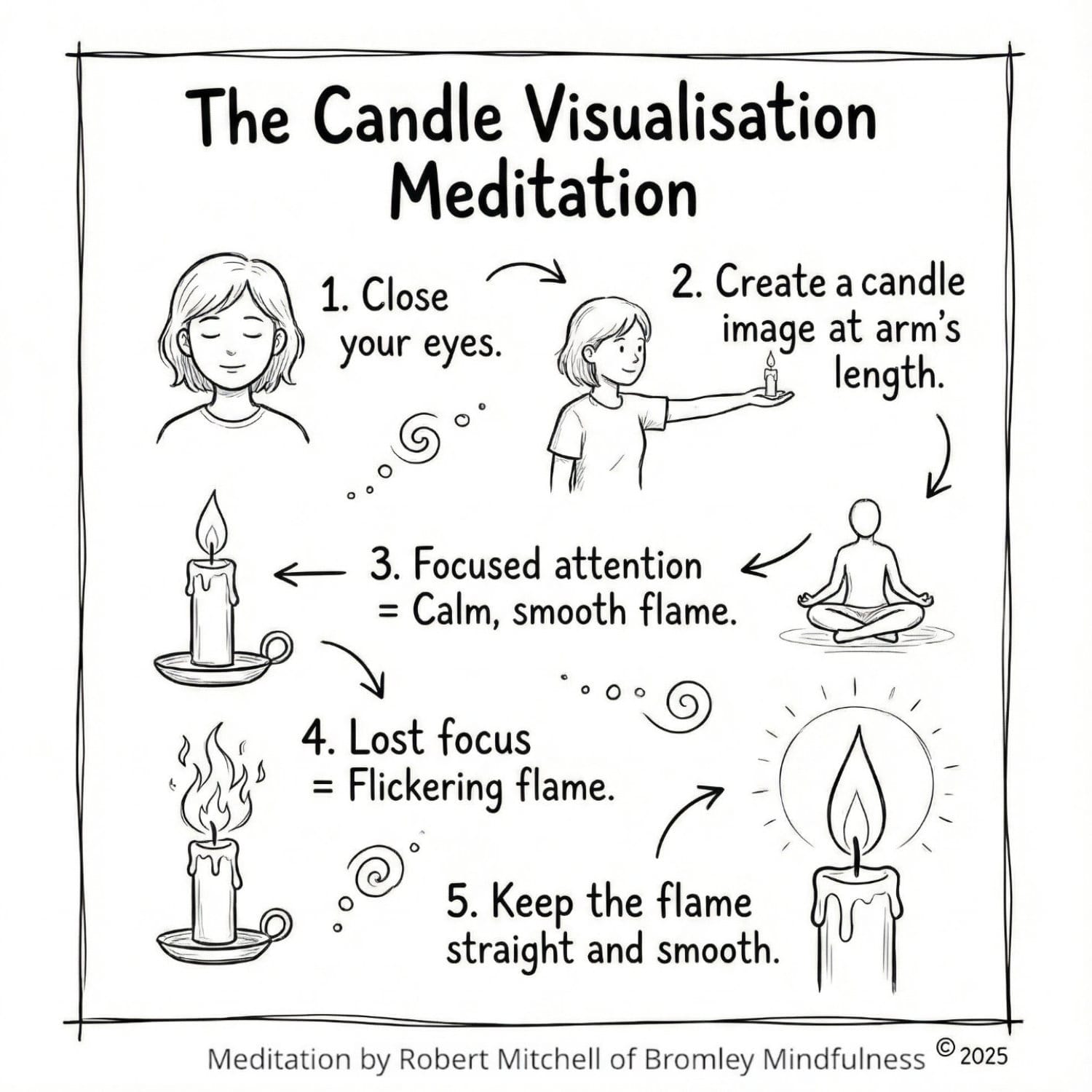
The Candle Visualisation Meditation
Close your eyes and imagine a candle at arm’s length in front of you 🕯
This candle flame can flicker, but you can stop the flickering by staying focused on it.
If you focus your attention on the candle, it remains calm and smooth.
If you lose focus, the canedle flickers.
Keep the candle flame straight and smooth. 🙏
P.S. This is a great practice for helping you fall asleep.

Mindfulness Meditation Explained
New Podcast Episode published 30 November
In this episode, recorded live during a guided meditation class in Bromley, Robert explores what mindfulness really is—and why it's far more than a stress reduction technique.
We look at how the mind automatically creates narratives about the past or future and how a single thought can derail our day—unless we spot it early. Mindfulness meditation is the training ground for that awareness.
What You'll Learn
- Mindfulness is noticing the present moment without getting lost in mental narratives about the past or the future.
- The practice trains your subconscious to alert you when your attention has wandered, giving you a choice about where to focus.
- Stress reduction and relaxation are side effects of becoming aware of your internal state.
- You learn that you are the observer of thoughts—recognising this neutralises the intensity of inner narratives and mental movies.
- Connection isn't something to seek. It's what emerges when we break the cycle of distraction and mental chatter.
The session then moves into a guided journey through focused-attention, calmness, and open-awareness meditations—simple yet powerful practices you can return to anytime.
Click the link to listen on your favourite podcast player:
https://podcasts.apple.com/gb/podcast/mindfulness-meditation-explained/id1434349351?i=1000738936782
Of Listen on Spotify our podcast host:

The Meditation Course is delivered as four live, online group-guided meditation classes each week. The course teaches practical, science-based practices to retrain your mind for resilience, focus, calmness, and connection.